The largest measurement can be misleading
A remnant may be 80 cm across at one edge and only 35 cm across where a corner has been cut away. Calling it “80 cm fabric” makes it look more useful than it is for a rectangular piece. Record a usable region, not just the greatest distance between two points.
Lay one remnant flat on a suitable surface without stretching it. Note holes, cutouts, marked areas and other constraints relevant to your work. Decide whether you are recording one usable rectangle or several separate regions.
This is an inventory method, not a cutting recommendation. Pattern placement, grain direction, stretch, nap, motif alignment and seam allowances can change what your project needs. Keep that information with the dimensions.
A rectangular label for an irregular piece
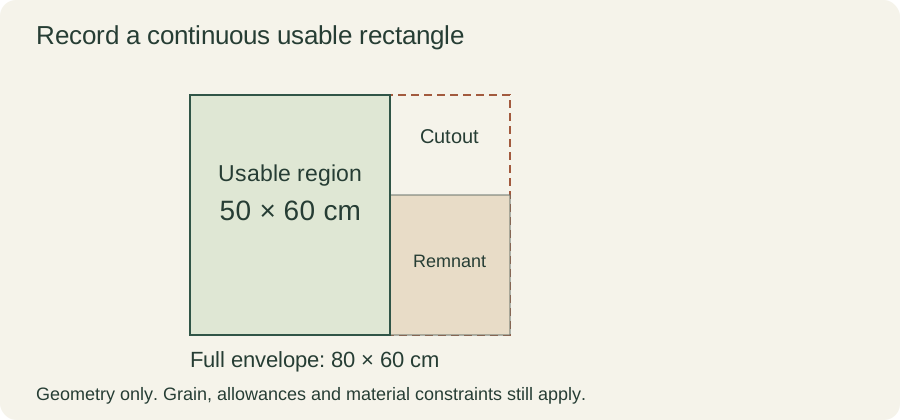
In an illustrative remnant, the outside envelope is 80 × 60 cm, but a cutout leaves a continuous rectangular region of 50 × 60 cm. The envelope area is 4,800 cm²; the recorded rectangle is 3,000 cm². The difference does not prove that all remaining material is waste. It means the larger rectangle is unavailable as one unbroken piece.
For a pattern piece requiring a 48 × 55 cm rectangle before any other constraints, the recorded region clears those dimensions by 2 and 5 cm. If the pattern requirement excludes seam allowances, add them before deciding. An orientation that fits geometrically may still be unsuitable for the fabric.
Write one label that avoids repeated unfolding
A concise label might read: “cotton remnant; clear rectangle 50 × 60 cm; direction arrow on attached sketch; notch at upper right; stored flat in folder C.” Material descriptions should reflect what you actually know. If the fibre or previous treatment is uncertain, say so.
Use a non-damaging label method suitable for the fabric and storage arrangement. Keep a small sketch beside the record when the shape matters; a numerical area alone cannot tell you whether a long narrow piece will fit.
File by the question your next project asks
| Question | Primary grouping | Extra detail |
|---|---|---|
| Is there a piece large enough? | Usable dimensions or size range. | Material, direction and shape constraints. |
| Is there more of this fabric? | Fabric identity or project origin. | Dimensions of each remaining piece. |
Choose one as the physical filing order and use a short list for the other. Duplicating the same remnant into two physical categories is impossible; duplicating the record creates an update obligation.
Update the record when you cut
Cross out the old dimensions after using part of the remnant. A precise but outdated label is worse than an honest “remeasure” note. Keep the rest only when its possible use justifies the space and future checking.
Store remnants according to their material requirements and the conditions of your space. The project parking card can keep pieces intended for one current project separate from the general remnant collection.
Prepared with AI assistance. Examples are illustrative unless explicitly identified otherwise. Published by Room for Everyday. Read our editorial approach or report a correction.