Measure the narrowest opening
A cabinet can be wider inside than it is at the door. Hinges, a central frame, and a partly opened door can reduce the space a box must pass through. Measure the usable opening as well as the interior. Record the smaller relevant measurement, not the number on the furniture listing.
For a shelf, measure clear width between the sides, depth from the front edge to the nearest obstruction, and height from the shelf surface to the underside above. Repeat at the front and back if the space is irregular. Use one unit throughout your notes.
For a drawer, account for the rails and for anything that hangs below the surface above it. A tall organizer may fit inside an open drawer and still prevent the drawer from closing. Test the full motion with a harmless temporary object before filling it.
Use the container’s outside dimensions
Capacity in litres tells you how much a container may hold. It does not tell you whether it will pass through your cupboard door. Look for the largest external width, depth, and height, including handles, lid clips, rims, and feet.
Tapered baskets introduce another complication. Their base can fit a shelf while their rim touches the sides. Measure the widest point. If you intend to stand folders inside, check the internal dimensions separately; an outside fit does not guarantee a useful inside fit.
If a listing does not say whether its measurements are internal or external, treat that as unresolved. Ask the seller, measure in person, or choose a container with clear measurements. Guessing to the nearest centimetre is unreliable when the proposed fit has almost no spare space.
Make space for the movement
Decide how you will access the contents. Will the box slide straight out? Will you lift off a lid while the box remains on the shelf? Will you pull a fabric handle from the front? Each movement needs different clearance.
The planner lets you reserve space at the edges and between containers. Those are your planning allowances, not universal safety recommendations. A comfortable allowance for a small tray may be inadequate for a heavy box or a lid that hinges upward.
Try a paper footprint or an empty cardboard box with the same outside dimensions. Rehearse the movement at the actual height. This catches awkward access that arithmetic cannot: a handle facing the wall, a door that catches a corner, or a box that would need tilting when full.
A worked shelf example
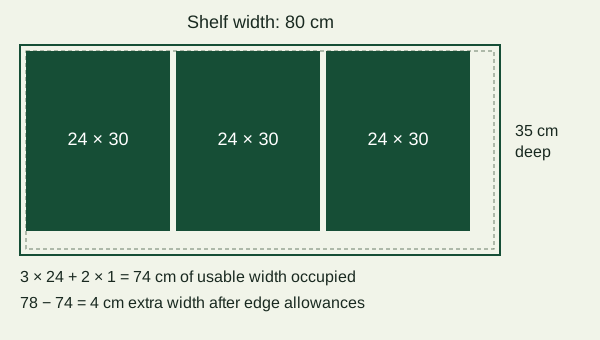
Suppose a shelf has 80 cm of clear width and 35 cm of depth. A container measures 24 cm wide by 30 cm deep. Reserve 1 cm at each outside edge and a 1 cm gap between boxes.
Three containers need 3 × 24 + 2 × 1 = 74 cm across. With 2 cm reserved at the outer edges, that leaves 4 cm of additional width. One row needs 30 cm of depth, leaving 3 cm after the front and back allowances. Turning the containers makes them 30 cm wide and 24 cm deep, so only two fit across.
This comparison is a single layer in a regular grid. It does not prove that three filled containers meet the shelf’s weight limit, nor that the boxes will slide past its hinges. Check those separately.
Usable opening; clear shelf dimensions; maximum outside container dimensions; access motion; manufacturer’s load and installation instructions.
Choose access over the last few centimetres
A layout with fewer boxes can be the more useful one. If two containers fit with their handles facing you, but three fit only sideways with inaccessible handles, the higher number is not necessarily the better choice.
Likewise, a second row doubles some counts on paper but may hide everything at the back. Put rarely used, clearly labeled objects there, or choose a shallower layout. The planner reports geometric capacity; you decide whether the arrangement suits daily use.
Save the measurements you actually used, along with the date and the location of the shelf. A note that says ‘hall cupboard, middle shelf’ is much more helpful on a later shopping trip than a photograph of a tape measure with no context.
Four fits that look similar on a shopping page
The following is a calculated comparison, not a product test. Keep the same 80 × 35 × 30 cm shelf, with a 1 cm allowance at each outside edge and above, and a 1 cm gap between containers. Its usable space is 78 × 33 × 29 cm. Changing just one measurement changes the answer.
| Example | Dimensions or restriction | Result |
|---|---|---|
| Baseline box | 24 × 30 × 20 cm | 3 across, 1 deep; 4 cm extra width and 3 cm extra depth after allowances. |
| Wider rim | 26 × 30 × 20 cm at the widest points | 2 boxes in either regular orientation. Three need 80 cm before the outside allowances. |
| Taller lid | 24 × 30 × 29.5 cm | 0 with the chosen top allowance: 29.5 cm is greater than the 29 cm usable height. |
| Narrow doorway | Baseline box; opening only 22 cm wide | The shelf calculation still says 3, but the 24 cm box cannot pass straight through that opening in the planned orientation. |
The doorway example is why a capacity result is only the beginning. Do not assume you can tilt a filled container just because an empty one can be manoeuvred through. Change the box or verify the whole movement with a lightweight mock-up.
Make a decision when the measurement is uncertain
Write down a range if a measurement is hard to read. Suppose the usable opening might be 24.0–24.4 cm and the box rim might be 23.8–24.2 cm. Comparing the generous numbers makes the box appear to fit. Comparing the smallest opening with the largest rim gives 24.0 − 24.2 = −0.2 cm: you cannot rely on a fit.
For a conservative shopping decision, use the smallest plausible clear space and the largest plausible outside container size, then reserve whatever handling space your own movement needs. This is a way to manage uncertain measurements, not a universal clearance standard. If the result depends on rounding down a rim or squeezing a handle, get a better measurement before buying.
Keep internal usefulness separate. A box can fit perfectly outside yet fail to hold an upright folder or a long utensil. Record those object dimensions as a second check.
Take this measurement sheet to the shop
One location, one set of measurements
Location / shelf: ____________________ Date: __________
Unit used throughout: __________
Smallest opening width / height: ____________________
Clear shelf width / depth / height: ____________________
Container maximum outside width / depth / height: ____________________
Required inside space for the contents: ____________________
Chosen edge / top allowance: __________ Between-box gap: __________
Handle direction and removal motion: ____________________
Uncertain measurement to verify: ____________________
Mock-up result: passes opening / slides out / lid opens / returns easily
Decision: keep existing / measure again / buy one to trial
Enter the verified shelf and container dimensions in the storage-fit planner. Keep the opening and movement checks on your paper sheet: the calculator cannot infer them from the shelf dimensions.
Prepared with AI assistance. Examples are illustrative unless explicitly identified otherwise. The original edition was reviewed by the owner on 18 September 2026. Later revisions are described above. Read our editorial approach or report a correction.