Start where the room gets stuck
A small living room can feel full even when there is not very much in it. The remote slips under a magazine. A bag occupies the only spare chair. The blanket has a home, but that home is behind two other things. These are small inconveniences; together, they make a room harder to use.
Begin with one moment you would like to make easier. Sitting down with a book is a better brief than ‘make the living room tidy.’ It tells you what needs to be within reach, what can live elsewhere, and whether the arrangement actually works.
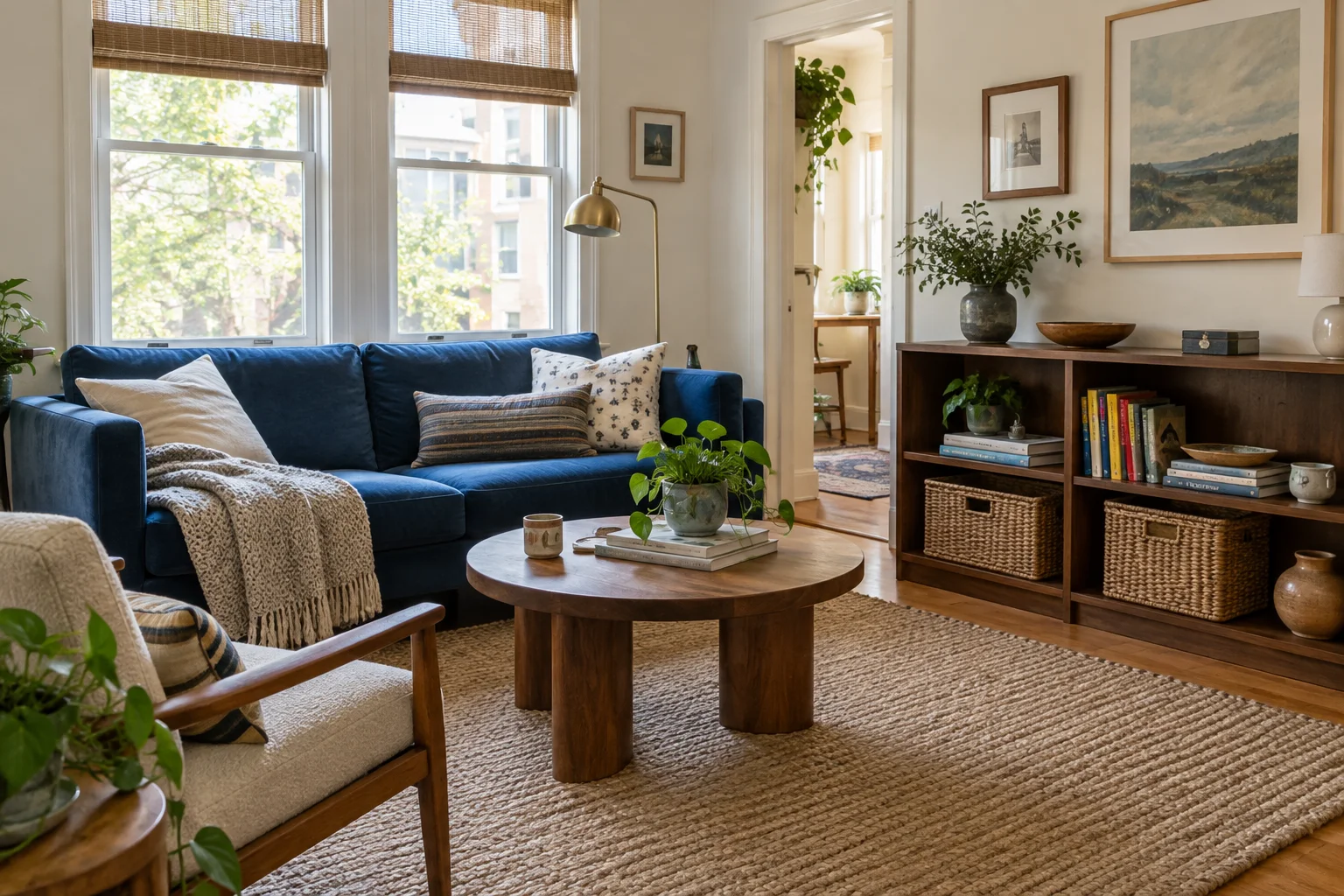
This guide uses an illustrative room with a sofa, a low shelf, and a small table. You do not need that furniture. The method is to watch one activity, give its objects a reachable home, and test the return journey.
Make a map of the ordinary evening
On a piece of paper, write down what you used in the room yesterday. Include the unphotogenic things: a charging cable, reading glasses, a tissue box, a half-finished puzzle. Then mark each item as daily, occasional, or passing through.
Daily objects get the most convenient spaces. Occasional objects can occupy a lower shelf or closed box. Things passing through need an exit route. If work papers arrive every evening but belong at a desk, a small return tray may be more useful than a permanent file system beside the sofa.
Do not sort the whole room at this stage. Pick the shelf or surface closest to the activity you chose. Keep the rest usable, especially if the living room is also your work or dining space.
When this object is put away, can the next person find it without asking you? If the answer is no, the system needs a clearer location or label.
Give the shelf three jobs
For a typical evening, one shelf might hold current reading, something soft, and small loose objects. Set a boundary for each job using what you already own. Books can stand between other books. A basket can hold a blanket. A shallow dish can catch the remote.
The boundaries do not need equal space. A thick winter blanket takes more room than a remote control; forcing both into matching containers creates a system for the containers. Let the objects decide the space.
Keep a little room around the things you use. A tightly packed shelf can look satisfying but require two hands and several movements to remove a single item. Leave the busiest container open if a lid would be opened and closed repeatedly. Reserve lids for objects that need protection or are used less often.
Do not mistake open space for an unfinished job. A small clear patch lets you set something down while reaching for something else. It is working space, like the clear part of a kitchen counter.
Try the return journey
Take out the blanket, open the book, and move the remote to wherever it would end up during an evening. Now put each thing back. Notice the point at which you have to lift something, crouch awkwardly, or carry an item across the room.
One awkward movement may be fine for a seasonal decoration. It becomes annoying for something used several times a day. Move the frequent object first, before buying a different container. If putting away the blanket requires removing the basket from a shelf, an open space beside the sofa may work better.
In a shared room, invite the other person to try the arrangement without explaining it. This is a test of the arrangement, not a test of their tidiness. If their instinct is to put an object somewhere else, discuss whether that location is actually more convenient.
Keep the room usable while you edit
Emptying every shelf at once makes a small room difficult to live in. Work with a temporary tray or a clear section of floor that does not obstruct the walking route. Complete one shelf before opening another.
Make a separate decision about objects with no current job. ‘Not on this shelf’ does not automatically mean ‘throw it away.’ It can mean a different room, a donation decision later, or a small holding box with a date to revisit. Keep that holding box limited to one place so uncertainty does not spread around the room.
Before moving furniture, check doors, drawers, and the route through the room. Storage should not interrupt a clear exit. Follow the furniture maker’s installation and load instructions; a layout that fits on paper does not establish that a piece is stable.
Review after ordinary use
Try the arrangement for several normal evenings. You are looking for repeat friction, not a perfect photograph. If the same object lands on the table every night, its assigned home may be too far away or too complicated.
Change one thing at a time. Move the reading pile closer, remove a lid, or make the blanket space larger. If you change every location together, you will not know which change helped.
A useful stopping point is simple: the seat is available, the objects for your chosen activity are easy to reach, and returning them does not require a second task. The rest of the room can wait for another day.
For a smaller first step, try the ten-minute closing routine. If containers are the sticking point, measure the available space with the storage-fit planner before shopping.
Prepared with AI assistance. Examples are illustrative unless explicitly identified otherwise. The owner has reviewed this article. Read our editorial approach or report a correction.