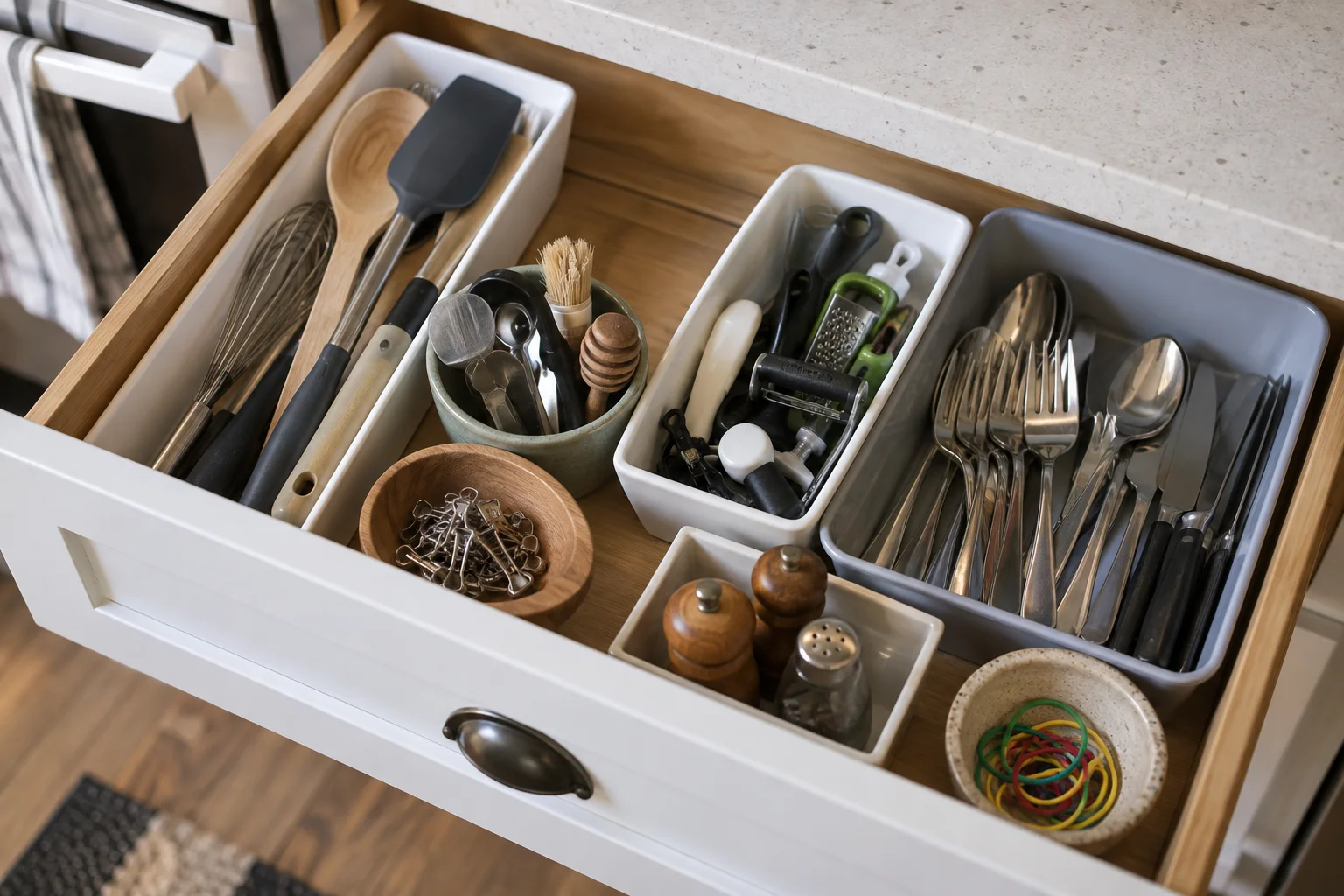
Empty one drawer, not the kitchen
Choose the drawer you open most often. Put its contents on a towel or tray, keeping sharp items safely separated. Wipe the empty drawer and let it dry. This is a small project; avoid spreading its contents across every working surface.
Sort utensils by the task they serve. Eating utensils might belong together. Cooking tools might need a different zone. A measuring spoon used for baking does not have to share space with a large serving spoon just because both are spoons.
Lay out the longest object first
Place the longest frequently used utensil in the drawer, then work around it. If you start with several small symmetrical compartments, the long tool often ends up lying diagonally across everything else.
Try empty food containers, shallow boxes, or trays you already own. Use only clean, dry, suitable containers with smooth edges. A paper box can help test a layout, but it will not be as washable or durable as a purpose-made divider.
Leave the front of the drawer for the objects you reach for most. Keep occasional serving pieces toward the back if they can remain accessible. Close the drawer gently while it is still sparsely filled to check height and motion.
Test with a real task
Imagine setting the table, making breakfast, or putting clean utensils away. Can you see the category at a glance? Do you need to rearrange one compartment to return a single item? Make the busy compartments generous and the seldom-used ones smaller.
Do not fill the remaining spaces simply because they exist. A spare strip can hold an unusually shaped tool. If an organizer shifts, first check whether the shape is a poor fit; repeatedly adding small filler objects tends to recreate the clutter.
Buy only for a specific failure
After a few days of use, note what is still awkward. ‘The teaspoon compartment slides into the serving tools’ is a specific problem. ‘The drawer does not look coordinated’ is an aesthetic preference. Either can matter to you, but they call for different decisions.
If you buy a divider, take your tested layout and the internal measurements with you. Keep usable existing pieces. There is no practical requirement for every compartment to match.
Work through a 44 × 48 cm drawer
This invented layout shows how to check a plan before choosing organizers. It is not a report from a tested kitchen. Suppose the clear drawer interior is 44 cm wide, 48 cm front to back and 7 cm high. You have three trays measuring 9 × 32 × 5 cm outside, plus a long utensil needing a 12 cm-wide lane. Reserve 1 cm at each side and 1 cm between neighbouring zones.
Across the drawer, the plan needs 1 + 9 + 1 + 9 + 1 + 9 + 1 + 12 + 1 = 44 cm. The three trays therefore fit the paper plan exactly, including the stated allowances. They do not have extra width beyond those allowances. If a rolled rim makes each tray 9.5 cm wide, the same layout needs 45.5 cm and no longer works.
With 1 cm reserved at the front and back, there is 46 cm of usable depth. A 32 cm tray leaves 14 cm beyond its footprint; a 42 cm-long tool lane leaves 4 cm. These leftover areas are different shapes. A single full-width back tray would intrude into the long tool lane, even though it appears to fit behind the short trays.
Removing one 9 cm tray and one 1 cm gap leaves a 34 cm-wide arrangement under these assumptions. The extra 10 cm may be more useful for an awkward tool than another narrow compartment. Use paper footprints to compare both options.
The tray's 5 cm outside height leaves 2 cm below the stated clear height, but the utensils can stand above the rim. Check the highest loaded point and the drawer's closing path. This arithmetic does not test either one.
Use three tasks to decide what to change
Instead of judging the drawer by a photograph, try these tasks with the proposed layout. The notes below describe things to observe; they are not claims about results you will get.
| Task | Notice | One possible adjustment |
|---|---|---|
| Set one place at the table | How many other objects must move before you can take the cutlery? | Move the daily cutlery to the front or separate overlapping pieces. |
| Return clean utensils | Does each item have an obvious place without repacking its neighbours? | Widen the busy tray or remove duplicates from that drawer. |
| Take out the longest tool | Does it catch another tray, hang over an edge or need a diagonal movement? | Keep its full removal path clear, not just its resting footprint. |
Repeat after ordinary use, with the same tasks. Compare one change at a time. If you cannot tell whether a change helped, record that rather than giving it a positive score because it looks neater.
Drawer trial record
Drawer and date: ____________________
Task that is awkward: ____________________
Before: what else must move? ____________________
Single change made: ____________________
After ordinary use: better / unchanged / worse
What happened, in one sentence: ____________________
Next decision: keep / adjust / undo / trial one new piece
Prepared with AI assistance. Examples are illustrative unless explicitly identified otherwise. The original edition was reviewed by the owner on 18 September 2026. Later revisions are described above. Read our editorial approach or report a correction.