Start with the board’s destination
A puzzle may fit on the dining table but still have nowhere to go at dinner. Before beginning, identify a flat, supported resting place for the board and a clear route to it. Measure the entire board, including any handles, raised edges or covers.
The completed-puzzle dimensions are only one input. Loose pieces, sorting trays and the box lid may need separate space. The number of pieces is not a reliable substitute for the actual finished dimensions printed on your puzzle.
Check the board’s instructions for support, carrying, closure and storage orientation. A flat board that can support a puzzle on a table is not automatically designed to carry it unsupported or stand upright.
Three rectangles with different jobs
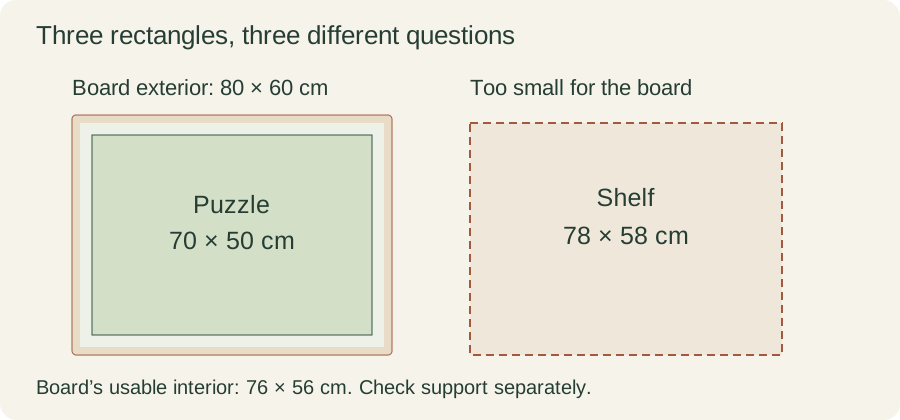
In this illustrative example, the finished puzzle is 70 × 50 cm. A board has an outside footprint of 80 × 60 cm and a usable inside area of 76 × 56 cm. The puzzle fits inside with 6 cm spare in each direction in total, or 3 cm per edge if centred.
The dining table measures 120 × 80 cm. The board fits on it, but the intended storage shelf is only 78 × 58 cm. Each shelf dimension is 2 cm smaller than the board. Comparing the puzzle to the shelf would have given the wrong answer.
Do not let the board overhang as a workaround unless its maker allows that support arrangement. Choose a suitable destination or a different board before assembling the puzzle.
Do a dry move with no puzzle on it
- Place the empty board where it will be used.
- Put the sorting trays and reference image in their expected positions.
- Move the empty board to the proposed resting place using the permitted carrying method.
- Check whether a door must open, a chair must move or another person is needed.
- Bring it back and see whether the starting layout is still available.
A successful empty-board move checks the route, not its behaviour with a loaded puzzle. Keep within the maker’s instructions and do not assume a cover prevents every piece from shifting.
Separate the puzzle from the supporting clutter
Keep loose-piece trays, the picture and any unfinished subassemblies in a defined set. A board that leaves the table in one move does not help if six bowls of pieces remain on the dining surface. Record which items must travel separately.
Agree when the table needs to return to meals or work. A named changeover point avoids discovering the storage problem after food is ready. If the board has no permitted destination, choose another project size or timing rather than making the room negotiate around it.
Puzzle changeover record
Finished puzzle dimensions: ____________________
Board usable area and outside dimensions: ____________________
Supported resting place: ____________________
Separate trays and image location: ____________________
Who moves it and when: ____________________
The table-to-desk guide uses a similar changeover idea for working materials; the important difference here is preserving an assembled surface.
Prepared with AI assistance. Examples are illustrative unless explicitly identified otherwise. Published by Room for Everyday. Read our editorial approach or report a correction.