Start with one bed, not the whole cupboard
Pulling out a fitted sheet should not start a search through three piles for the pillowcases. A linen shelf works best when its groups match the way you change a bed. Start with the bed changed most often and gather the pieces you actually use together.
Keep uncertainty out of the finished group. If a sheet’s size is unclear, check its label or fit before labelling it. Set aside incomplete combinations while you decide what belongs together. This is a sorting exercise, not a rule that every sheet needs a matching colour or that every household needs the same number of sets.
Count complete changes, rather than individual pieces. Two pillowcases and a duvet cover do not necessarily make one usable change for your bed. Your own bedding arrangement determines what a complete group contains.
Choose between bundles and separate piles
A complete bundle suits a bed whose pieces are usually changed together. Fold the components as you normally would, then keep them beside or within a clearly identifiable outer piece if that makes retrieval easier. Keep the size label visible. Do not squeeze everything into a tight package merely to make the shelf look uniform.
Separate piles may be better if pillowcases are changed on a different schedule or shared between sets. In that case, put the frequently replaced item nearest the front and label the remaining groups by bed or size. A hybrid arrangement is reasonable: complete bed changes in one zone, extra pillowcases in another.
Only put linen away when it is ready for storage according to its care instructions. This layout does not address damp storage or replace fabric-care guidance.
A worked shelf with three jobs
This is an illustrative layout, not a measured home. Suppose a shelf has a clear width of 76 cm, depth of 35 cm and height of 32 cm. Mark three zones: 30 cm for one bed’s changes, 22 cm for another, and 18 cm for shared pillowcases. Leave two 2 cm gaps between groups and 1 cm at each outer edge.
The width calculation is 30 + 22 + 18 + 2 + 2 + 1 + 1 = 76 cm. These are allocations, not a claim about how many folded sets fit. Measure your folded bundles, including any container, before copying the plan.
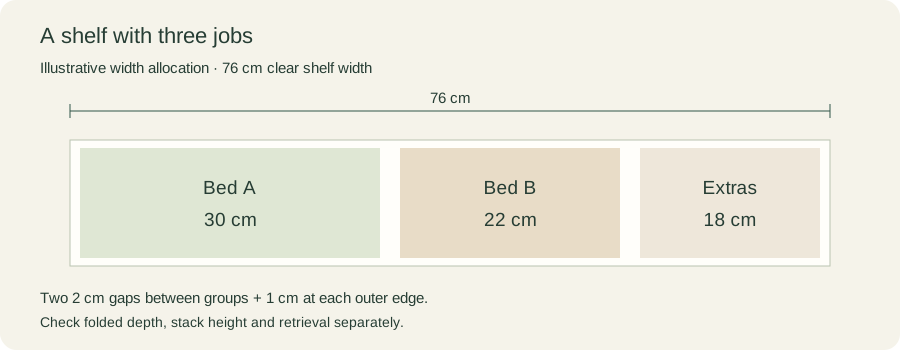
If your folded pieces extend deeper than the shelf, change the fold or choose another location. If the stack fills the entire height, removing one bundle may disturb the rest. The width diagram cannot tell you whether a stack is comfortable to lift.
Try the change with the cupboard as it is
- Approach with the door in its usual open position. Can you identify the correct bed’s group without moving another pile?
- Take the items for one complete change. Note what else you have to hold, move or set down.
- Leave the remaining linen as it would be while the removed set is in use.
- Return the clean, folded group later. Check that the space is still available and the label remains visible.
Retrieval is only half the test. If clean linen waits outside the cupboard because returning it requires rebuilding the whole stack, reduce the stack, make a wider group or change how the pieces are bundled. A small usable gap can be more helpful than a perfectly filled shelf.
Keep a short record, not a permanent inventory
One-bed linen trial
Bed or size: ____________________
Pieces in one complete change: ____________________
Folded group width / depth / height: ____________________
Items moved to retrieve the group: ____________________
What happened when the group returned: ____________________
After a few actual changes, decide whether to keep the arrangement. Use the label guide if sizes are still confusing, or the shared-shelf plan if several people use the same cupboard. There is no need to reorganize the remaining shelves until this one works.
Prepared with AI assistance. Examples are illustrative unless explicitly identified otherwise. Published by Room for Everyday. Read our editorial approach or report a correction.