There are three different spaces to measure
An under-bed box needs a place to sit, a route out and a place to open. Product dimensions describe the box; they do not describe all three spaces. A bedside cabinet can leave the box visible and still block the last part of its movement.
Measure the clear height below the lowest obstruction, including a centre rail where relevant. Then measure between legs or supports at the opening you intend to use. Finally, measure the floor outside that opening with nearby furniture in its normal position. Keep handles, wheels and an expanded fabric lid in the measurements.
This guide concerns loose boxes removed horizontally. Built-in drawers and lifting bed mechanisms have their own instructions. Do not alter the bed, its supports or a storage mechanism to make a container fit.
A 58 cm box beside a 46 cm aisle
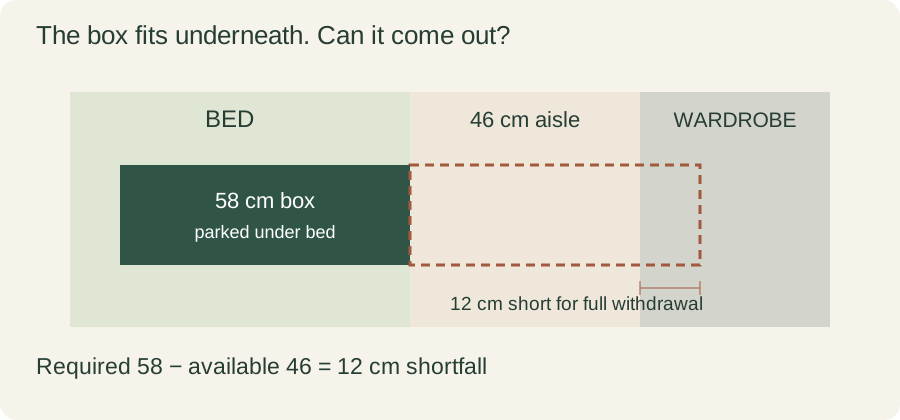
In this illustrative example, a box extends 58 cm inward from the side of the bed. The aisle between the bed and wardrobe is 46 cm wide. If the box must emerge completely in a straight line before opening, the available aisle is 12 cm too narrow: 58 − 46 = 12.
The box may fit perfectly while parked. That does not establish that you can get to its contents. A top lid that must lift fully outside the bed makes complete withdrawal important. A different opening may allow partial withdrawal, but check the exact product rather than assuming it.
Check your straight pull-out distance
Full-withdrawal check
Use the box’s full outside length in the direction it slides. This checks straight withdrawal only, without rotation. It does not check supports, height, lids or the space needed by a person.
Your measurements stay in this page and are not saved or sent.
Compare the route before comparing capacity
| Option | What changes | What to check |
|---|---|---|
| Turn the box | A shorter side may face the aisle. | Does the other dimension fit between the supports, and is the handle usable? |
| Use shorter boxes | Each unit needs less pull-out distance. | Count the extra handles, lids and return trips. |
| Withdraw from the bed end | The access route moves. | Are the end supports and foot-of-bed furniture clear? |
Moving the wardrobe every time is technically a solution, but record that as part of the work. A layout suitable for occasional stored decorations may be poor for bedding collected every week. Avoid claiming that a rotated box will clear a corner unless you have checked its whole movement.
Make a flat mock-up of the movement
- Mark the box’s outside footprint on paper or use an empty carton of the same footprint.
- Place it at the proposed starting point and move it through the actual opening.
- Check where your hands go and where the box rests while open.
- Return it without pushing against legs, wires or mechanisms.
A flat template checks only the floor route. Repeat with the real height and opening method before buying or committing to the layout. Keep the chosen route clear of everyday footwear and bags.
Write down the limiting dimension
Under-bed access record
Lowest clear height: ____________________
Opening between supports: ____________________
Box dimensions including handle and wheels: ____________________
Clear pull-out distance: ____________________
Where the lid opens: ____________________
Object that must move first: ____________________
For the dimensions inside a regular shelf, use the measuring guide. The limiting number here may be outside the storage area entirely.
Prepared with AI assistance. Examples are illustrative unless explicitly identified otherwise. Published by Room for Everyday. Read our editorial approach or report a correction.